The Star Trek Fandom
- 20 minsFandom, Identity and how to “Save” the Star Trek franchise:
What exactly does it take to consider oneself a “fan” of a certain cultural item? Certainly one element fandom is personal experience. Most people would be pretty willing to call themselves a “fan” of pizza given that the vast majority of us have had very positive and very delicious interactions with the food item. Additionally almost no one calls themselves a fan of a cultural item that they do not enjoy (except for for the ironic lolz). Yet personal experience is only one element of what we consider fandom. Many people watch part or all of several NBA or NFL games each year (or any other sport for that matter) but would not consider themselves “football fans” or “basketball fans”. Why is this? What exactly is a fandom once it moves beyond something purely related to an individuals enjoyment of some thing or another? To take part in this type fandom is no longer a statement of mere taste but a statement of identity. Because in addition to experience, fandom also contains an element of identity. When asked to conjure an image of a Green Bay Packers fan most of think of grown men with painted chests and styrofoam cheese on their heads. For this reason, a former resident of Wisconsin who watches a couple of Packers games each year might not call himself or herself a fan of the Packers in spite of having a positive connection to the team because he does not identify with this perceived identity of Packers fans. If we apply an understanding of fandom being something more than simply liking something we will be able to understand why the Star Trek fanbase is the way it and what can be done to ensure the franchise’s vitality as moves on from it’s fiftieth anniversary.
How exactly does a group of people go from being a collection of people who enjoy the same thing to being a distinct fandom with a unique identity? The identity of any fandom is defined by the existing community of fans. This is another reason we so easily call ourselves fans of pizza. People of all colors, shapes, creeds and holding every manner of pet conspiracy theory are pizza fans therefore we make no identifying statement when we label ourself “pizza fan”. Because any type of person can be a pizza fan. In the case of the Packers, however, the primary question is not whether you enjoy Green Bay Packers football but whether you identify yourself as having something in common with those passionate cheese heads. By making a declaration of fandom them we are making a statement of identity and placing ourselves within a social group because these fandoms are include an element of shared identity. Every cheese head has something in common and this thing we share in common in important enough for us to form some sort of community around. This is why when you stumble upon a fellow member of a fandom you are part of you feel an instant connection, because you are fellow members of a community. Shared experience is one thing, having a shared experience of enjoying wine makes great table conversation, but shared fandom is much more powerful. This is what makes us want to boo the random person wearing our rivals gear. There is an ‘us’ and they are not part of it.
With a general understanding of the relationship between fandom and identity, and the power of this relationship in mind, let’s start to examine the Star Trek fanbase. Star Trek fandom is one such fandoms that confers on the fan a certain identity and membership with an established social group. Which isn’t to say that all Trekkies must learn Klingon and dress up for conferences (although more power to you if you are) but if someone professes to be a Star Trek fan, we assume they share some at least similarities with other Star Trek fans and belong to the same broad social category. This because “Trekkie” is an established identity and so when we meet a new Trekkie we begin applying this identity to them. This identity goes something like this: probably academic, most likely male, likely to be interested in the sciences and technology. Of course, not that all Trekkies meet this description, but this our baseline assumption of what Star Trek fans are like.
Making such broad generalizations across a group of people as large fans of Star Trek is bound to be wrong much of the time, but the surprising thing is that these stereotypes actually do reflect certain truths about the demographics of Star Trek fans. What’s even more surprising is that these underlying demographics have been relatively stable have been relatively unchanged for almost half a century. When the original Star Trek series ran on NBC in the 1960’s the show’s overall rating were unimpressive and the show was cancelled after just three seasons. In these early years NBC stated that the shows small fanbase consisted of “upper-income, better educated males”. This is not far off from the generalizations about Star Trek fans stated above. In fact, in the early years the shows creators touted letters of support from scientists and university professors as demonstrating the types of individuals drawn to the show. Amazingly these threes descriptions of the Star Trek fanbase remain relatively unchanged 50 years later. Below are three sets of graph showing the percentage of people who responded positively to the question “Do you consider yourself to be a fan of the Star Trek franchise
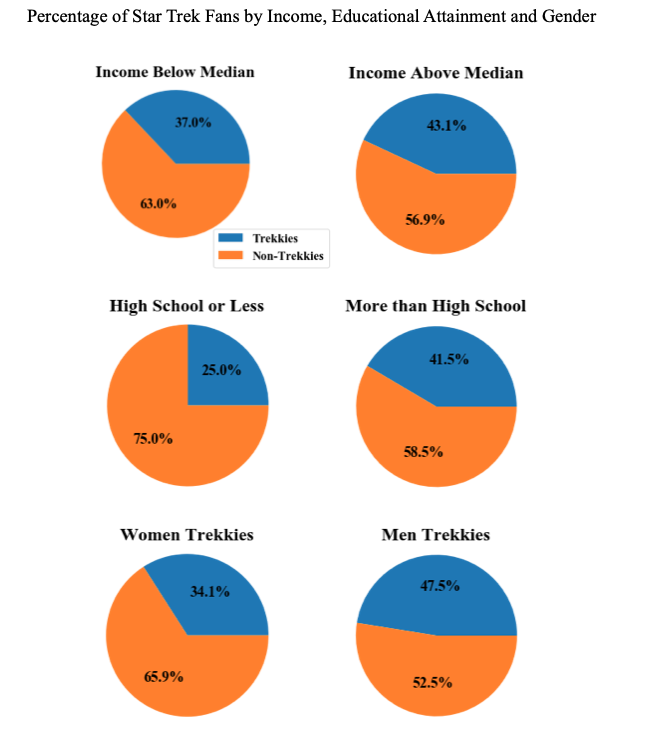
We can see from the graphs above that gender, education level and income level are all correlated with Star Trek fandom. This seems pretty amazing at first. How is it that a show that originally ran just three seasons in the late 1960’s and has gone through many different iterations, including a recent trilogy of commercially successful blockbusters has maintained the same fanbase demographic for half a century? Part of the answer lies in the conversation we had earlier about what exactly it means to be a fan of something like Star Trek. Because Star Trek fandom goes beyond simply how one responds to any given film in the series, the fanbase is less prone to change and trend. An individual who does not identify themselves with the culture of science-oriented men is unlikely to start calling themselves a Star Trek fan simply because they like Chris Pine in the most recent trilogy. Likewise a person who strongly identifies with the culture of science fiction is unlikely to change his or her thoughts about the whole franchise based on one mainstream oriented film, even if they might grumble about the franchise new orientation but we’ll talk about that later. The other part of the answer has to do with the individuals who react to this type show.
The fact that the Star Trek fanbase has remained relatively unchanged over the last fifty years is just one piece of evidence demonstrating the unique relationship between the franchise and its fans. Star Trek has always been a fan driven show, by that I mean the shows influence has always come from a set of dedicated and passionate fans unlike most TV shows who fans move on to the next show once they get bored or the show is cancelled. This is true from the first iteration of Star Trek, as I mentioned earlier, the original series did not garner a large audience but the even from the beginning the people who liked Star Trek really liked Star Trek. When rumors surfaced that the series was on the brink of cancellation after its second season there was a massive letter writing campaign aimed at saving the series. Students from Caltech marched on the NBC studios in attempt to save the stop Stark Trek’s cancellation, additionally students from Berkley and MIT also held demonstrations. This demonstrates that the from the very beginning the Star Trek audience was fundamentally different from the standard audience of TV show. It also indicates that if you are frustrated with a TV show being rebooted to death in response to fan outcry over its cancellation (See: Community) you might have Star Trek to blame for starting this madness in the first place. It is the core of extremely vocal and educated fans that began to create the idea of the Trekkie as a distinct type of individual. Both the passion of early Star Trek fans, and the fanbase’s relative consistency through the year tell us that Star Trek’s cultural relevance and continued popularity relies on the support of an energized and consistent group of fans of the franchise.
When considering a fanbase’s ability to remain relatively unchanged after such a long period of time it is important to also consider the barriers to entry for the fanbase. There are two basic types of barriers to entry into a community: those from intrinsic to the group itself and extrinsic to the group. Basically factors having to do with the group itself it’s makeup and beliefs about membership and factors relating to how others view the group and its members. The extrinsic barriers to entry to the Star Trek fanbase can be easily summarized with the term “geek”. For most of the time since the shows original creation being geek was an identity which could not be held without facing significant social repercussions. Geeks were not cool and Trekkies were geeks, therefore no matter how much you might enjoy watching the TV show, you couldn’t identify as a Trekkie unless you were willing to face the social ramifications of identifying as a Trekkie.
The intrinsic set of barriers to being a Trekkie primarily has to do with the make up of the fandom in general. Being so associated with wealthy, educated males means that individuals who do not belong to those groups would be likely to feel excluded from these groups regardless of how they felt about the franchise itself. When society stereotypes Trekkies as being men it makes women and girls feel that this identity is not available to them and to take on this identity would be inappropriate. The same logic applies to education level as well. If all Trekkies are smart and educated then individuals from a different educational background may feel intimidated or unqualified for membership in the club. This holds true whether Star Trek fans actively applied these restrictions themselves, which certainly happened in some cases, or not.
I don’t want to seem here like I am praising Star Trek fandom for excluding women and people who only have a high school degree. As I mentioned, intentional exclusion does exist and that is truly unfortunate. However, I do want us to consider that educated men who are interested in science and science fiction might actually have distinct entertainment choices from society in general. What is impressive about the Star Trek fandom is not that they have managed to keep women out so long but they have managed to form an enduring group identity although the two cannot be totally untwined.
After considering the relationship between Star Trek fans and the franchise itself it is pretty easy to see how the latest series of films is an affront to the fanbase. The reboot throws out the things that make Star Trek unique, the things that give it its stable and loyal fanbase, in attempt to create Star Wars 2.0. Star Trek fans themselves said as much when they ranked the 2009 Star Trek among the middle of Star Trek films and ranked Star Trek Into Darkness as the worst Star Trek film of all time at recent Star Trek convention. This highly contrasts to the reaction it got literally from the culture in general: Metacritic has it at a 72, IMDB has it at a 7.7, and the film was a hit at the box office. This drives home the point that being a fan of Star Trek goes beyond simple enjoyment of any particular Star Trek manifestation to something more closely linked to identity.
The problem with the most recent Star Trek trilogy is that it discards all of the things that make Star Trek unique in an attempt make the films more like Star Wars. The films contain almost no true elements of sci-fi and are essentially action/adventure movies set in space with the trappings of the Star Trek universe pasted on. The fact that JJ Abrams directed two films in the trilogy and then went on to direct the first film in Disney’s Star Wars trilogy illustrates that the creators of these films may not see a huge difference between the two franchises. There is only one problem with this: Star Trek is not Star Wars. The graph below represents the percentage of survey respondents who claimed to be fans of the Star Wars and Star Trek fanbase respectively. 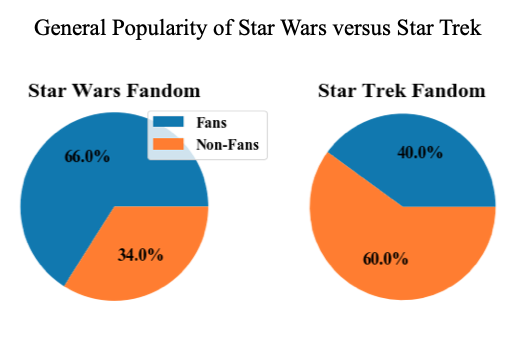
While Star Trek holds a special and important place in American culture it is not nearly as ingrained in the mainstream as Star Wars is. We see this at the box office as well. The new Star Trek series did quite well at the financially but The Force Awakens was one of the highest grossing films of all time when it came out.
We live in an age where any creative property of worth at all is being churned into money making films and television series. Super heroes previously unknown to wider audiences like Shazam and Antman are getting their own films, the Hobbit was stretched into a three film behemoth, and HBO started adapting A Song of Fire and Ice before the books were even close to being finished (the TV series is now already finished while fans of the book series cling to on to the hope that George RR Martin will be able to finish at all). In spite of their different costumes, different universes with unique features, these films all remain essentially the same. That is they seek to excite the same reaction in the film goers by showing them a good time and a little excitement without offering much else of substance. In the midst of all this universe overload, certain franchises are so firmly entrenched within the mainstream that they stand in no real danger of being drowned out by the noise. Star Wars because of it’s overwhelming popularity is one such franchise, although A Solo Story demonstrates that even Star Wars can get passed over when there are so many other options. But as I said, Star Trek isn’t Star Wars and with so many franchises competing for the mainstream, Star Trek is easily lost among the noise. The question is: why fight for mainstream audience with there is a better alternative? The passionate and consistent Star Trek fandom is the lifeblood of the Star Trek franchise and ignoring this fanbase to chase after fickle and inundated mainstream viewers is a pretty big mistake.
How then can the creators of Star Trek make something that fans would actually be excited about? Once again, we can answer this question by simply investigating the fanbase. If we go back to the original fanbase and see what excited about the fans about it in those early years we can see what distinguished the show then from the Star Wars copycats of recent years. The reason that the early Star Trek captured the minds of students at the countries best colleges boils down to two simple factors - imaginative science fiction and legitimate social commentary. That is what is what the most recent round of Star Trek films was so clearly lacking.
Some would argue, however, that the latest television series Star Trek discovery does something to address these issues, but there are a host of problems with the show. For one, the show has done very little to excite a cultural reaction. Recent indicators seem to show that they show is decently popular but the shows restriction to the CBS streaming service within the US has stopped it from generating any real buzz in the general culture. Certainly not anything like the letter writing and demonstrations of the Original Star Trek. The show has taken a step to include a more diverse cast in terms of gender, race and sexual orientation and this hints Star Trek Discovery is interested in social commentary. And while I celebrate the fact that Star Trek Discovery includes such a diverse cast, in 2019 this no longer qualifies as engaging social commentary. We live in the age where Wonder Woman and Black Panther were massive hits at the box offices and we have a gay man running a successful campaign for the Democratic presidential nomination. Not to say we can rest on our laurels and stop worrying about representation because this type of representation on television is extremely important and I am glad that Discovery is doing well with it’s diverse cast. But I believe that this is now the baseline for what is expected of progressive shows and Discovery is not really challenging its viewers to explore new social or moral territory. The reactions to the show drive this point home, those in favor of diverse representation praise the show, those claim to hate identity politics playing criticize the show for forcing it’s views on watchers, Discovery is not provoking or challenging anyone within its audience.
In my opinion, one blueprint for a more interesting and engaging sci-fi experience would be Netflix’s Black Mirror (which also features a racially diverse cast but goes far beyond that). Black Mirror’s popularity and the feeling of novelty it gives the viewer demonstrate that not only is there lots of new territory to be discovered in the realms of sci-fi film and television, but that this type of exploration can be popular with audiences. The world of technology has changed massively since the 1960’s and the fact that universe of Star Trek has not evolved to keep up with this change demonstrates that its creators are no longer interested in pushing any sci-fi boundaries. While I understand that most of the technological changes have happened down here on earth and the way we envision space exploration hasn’t really changed there is still plenty of room for imagining how our current technologies and the possibilities they create might change how we explore other worlds (once we get to them). This is where Star Trek has a huge opportunity. While Black Mirror is many things, it is not nearly as light hearted or fun as the Original Star Trek series was. A new Star Trek series could be the yang to Black Mirror’s yin. Tackle the issues of social change and technological advancement and show how human society might use these things for good. This is very much in line with Star Trek’s creator’s vision of the utopian Star Federation, the idea that maybe we can use the things we will invent to become more peaceful and more understanding. Take the example given by Black Mirror that shows that audiences are interested in asking questions about how technology will change us and our society, but as how they will change space exploration and interactions with other species and ramblings on other plants but also asking these questions with a feeling of optimism. This is another area where Star Trek Discovery is a failure. In 2019 pessimism and despair over the state our institutions is pretty widespread, the desire for systemic change seems to be everywhere. Star Trek Discovery by showing cracks in the Federation system and focusing on mutinous feelings within Star Fleet itself merely echos the current cultural zeitgeist instead of attempting to offer something that would be truly refreshing and honestly challenging in the age of Trump. This combination would provide a blueprint for a new Star Trek series that would actually be fresh and compelling and might cause that traditional Star Trek fanbase to get truly excited about the franchise for the first time in a long time.
All these thoughts about what a new Star Trek series should look like stem from what we know about fanbases generally, what we know about Star Trek fans specifically, and applying this knowledge to see what could be done to excite the surprisingly loyal Trekkie fanbase instead of appealing to mass audiences like every other creative property. Why do this? The recents series of films was relatively successful and people are watching Star Trek Discovery. The problem is that these kinds of properties water down the franchise in general. Mass audiences who may have enjoyed a new Star Trek film will quickly move on to something else (As they did with the third installment of the most recent trilogy which lost money at the box office) and through continual ignoring of hardcores fans you will undermine the enthusiasm of existing fans and ensure that potential new Trekkies get their science fiction fix elsewhere (as illustrated by my brother who recently started watching a Star Trek copycat in lieu of Star Trek Discovery). The Star Trek fanbase has demonstrated that it can remain strong even after several generational changes, to ignore this impressive feat will ensure that the Star Trek franchise moves closer and closer to irrelevance.
This essay is based on an analysis of a survey conducted by the website fivethirtyeight.com
This data can be found here
The fivethirtyarticle about the same survey data can be found here
And my Jupyter Notebook for analyzing the survey data can be found here on github